
Reading: The Story of Film by Mark Cousins (Introduction and Chapter 1)
Viewings: Cinderella (1899), the arrival of a train at la ciotat (1897), the infernal cauldron (1903), the four troublesome heads (1898), a trip to the moon (1902)
![Amazon.com: A Trip to the Moon Restored (Limited Edition, Steelbook) [Blu-ray] : George Melies, George Melies: Movies & TV](https://m.media-amazon.com/images/I/81muMUB-R+L._AC_UF894,1000_QL80_.jpg)
In my first week of self guided film education, we started — well, at the start. The late 1800s brings the advent of cameras capable of capturing images rapidly enough to then be projected and create the illusion of movement. It didn’t take much time at all for creatives (and businessmen) to see that there was real opportunity here and innovation in the art form came swiftly.
I had seen A Trip to the Moon before (shoutout Mrs. Shank’s digital photography class) but Mark Cousin’s commentary as well as the other viewings really helped me contextualize what this new thing was like to the first moviegoers around the turn of the 20th century. The form wasn’t ready to contend with the artistic mediums it contends with now, these films aren’t analogous to literature, most of them have no narrative at all. They’re spectacle.
Apparently, showing a layperson a 40 second video of a train arriving at a station is the equivalent of giving a medieval peasant a flavor blasted goldfish.

This was one of the first films widely shown and by Cousins’ account people were screaming and ducking and running out of the theater, thinking the train was going to burst through the screen and into the theater. It was a thrill ride, a carnival sideshow, a chasm away from what the medium would eventually become.
It’s not that they didn’t know what they had, quite the opposite actually — they were working to innovate and create new techniques and technologies that ultimately created the fundamental building blocks of film. Conventions that we take for granted like cutting from one shot to another, using a dolly to keep camera movements smooth (or even moving the camera at all), or cutting to a close up to provide more detail to the viewers, all had to be invented out of thin air by one of these creators before they could be borrowed and built upon. To my surprise, some of these creators even used flashier techniques like re-exposing film to create a ghost-like effect (check out the Infernal Cauldron on Max) or changing the focus to intentionally blur an image and create a dream-like effect, or using cuts and props for special effects. I would have thought these techniques wouldn’t be developed until much later, but they’re used to great effect in some of these early films.

A film I was not able to watch, but was interested to read about was The Corbett-Fitzsimmons Fight (1897). It’s credited as being the world’s first feature-length film, though the only narrative it features is that of an actual boxing match that was filmed and then projected in pop-up picture houses across the USA. Aside from making history for its length, what I found particularly noteworthy about this is the commentary surrounding the release at the time. The fact that the first American feature film depicted something as low-brow and populist (by the convention of the time) as a boxing match signaled a notion that would persist in some form for the next 100 years — that while international filmmakers (especially the French) would create ‘art’, American cinema was for populist entertainment. Popcorn flicks for us yanks. This is obviously a huge generalization that is mostly untrue, but I found it fascinating that the sentiment literally goes as far back as the medium itself. As for this criticism, I echo the speech delivered by Brad Pitt in Damien Chazelle’s Babylon, the beauty of film is in both its artistic value AND its accessibility.
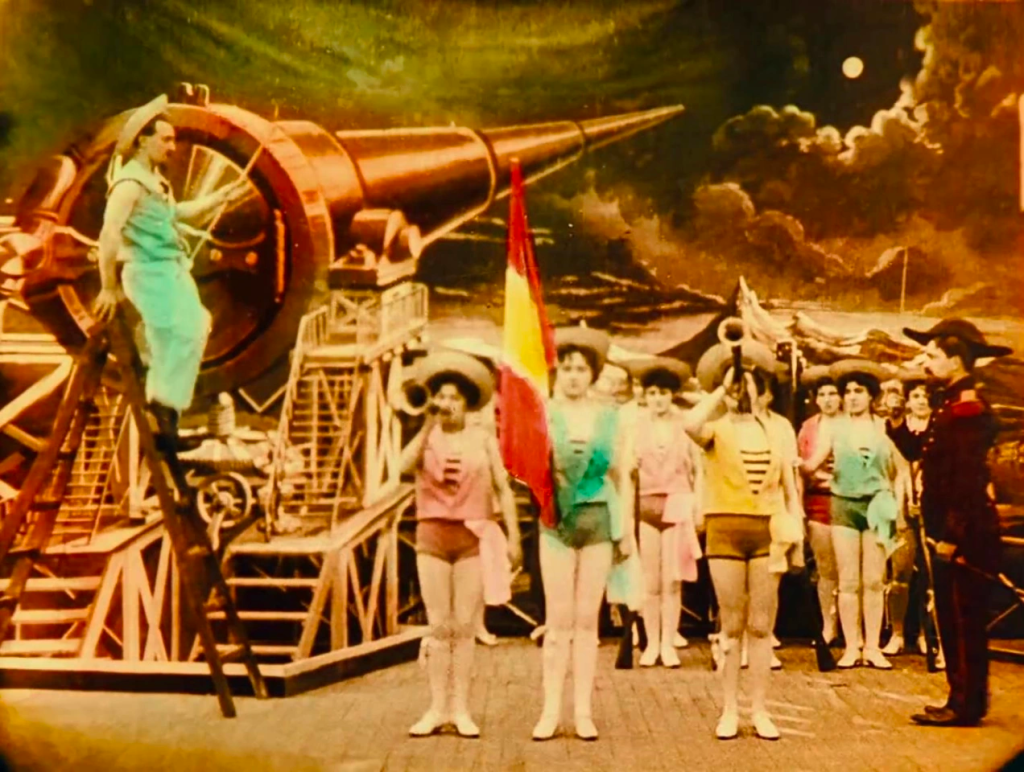
As for A Trip to the Moon, it makes sense why this is the film most often shown to film students when covering this era. Nearly all of the techniques mentioned earlier in this post are used. There is a narrative, but it’s not really the point, the point is still the spectacle of watching our heroes go to the moon, fight aliens, and come back for some celebration with the strangely orderly and oddly clad women in the image above. In conception and execution it really impresses considering it’s just five years removed from simple clips of trains being shown in theaters. I would recommend this to anyone with an interest in film history, but I would also strongly recommend pairing it with some of these other short films from the turn of the 20th century. I found The Infernal Cauldron, and The Four Troublesome Heads to be particularly charming and technically impressive, but I also think checking out something like The Arrival of a Train at La Ciotat helps give a lot of context to what we were working with in these early days.
Super fun start to this journey! I’m excited to move into more narrative films in next week’s lesson The Silent Era and Expressionism. See you then!
 Loosely Scripted
Leave a comment