
READINGS: SOUND HISTORY IN FILM: EARLY RECORDING, 10 Great Early Sound Films, How Movies Went From Black and White to Color, Remembering Hollywood’s Hays Code, 40 Years On, Omnibus Podcast Episode 436: The Hays Code
VIEWINGS: Dickson Experimental Sound Film (1894), THE JAZZ SINGER (1927), Blackmail (1929), Flowers and Trees (1932), The Wizard of Oz (1939)
As I mentioned in my last post, the next unit of this course jumps all the way to 1942s Casablanca, to exemplify the Golden Age of Hollywood, which would have us skipping over the 1930s entirely. I decided I wanted to cover this period to try to bridge the gap between the silent era of the 20s and the golden age of the 40s. I focused my research on what I thought to be the most influential developments of the 30s: the rise of sound, the introduction of Technicolor’s three-color process, and the establishment of the Motion Picture Production Code AKA the Hays Code.
Sound
I started my research on what is probably the most obvious difference between the films of the 20s and those of the 40s – sound! They’re talking and you can hear them talk. You can synchronize and standardize score. You can add sound effects. This is of course standard and expected for modern audiences (I can’t say I will miss reading the intertitle cards), but it marks a monumental shift in the medium (Wheeler Winston Dixon marks the history of film in three eras: silent, sound, and digital). Of course everyone knows the gist of the history – films used to be silent and now they aren’t – which is most of what a layperson would need or want to understand but there were some interesting nuances.
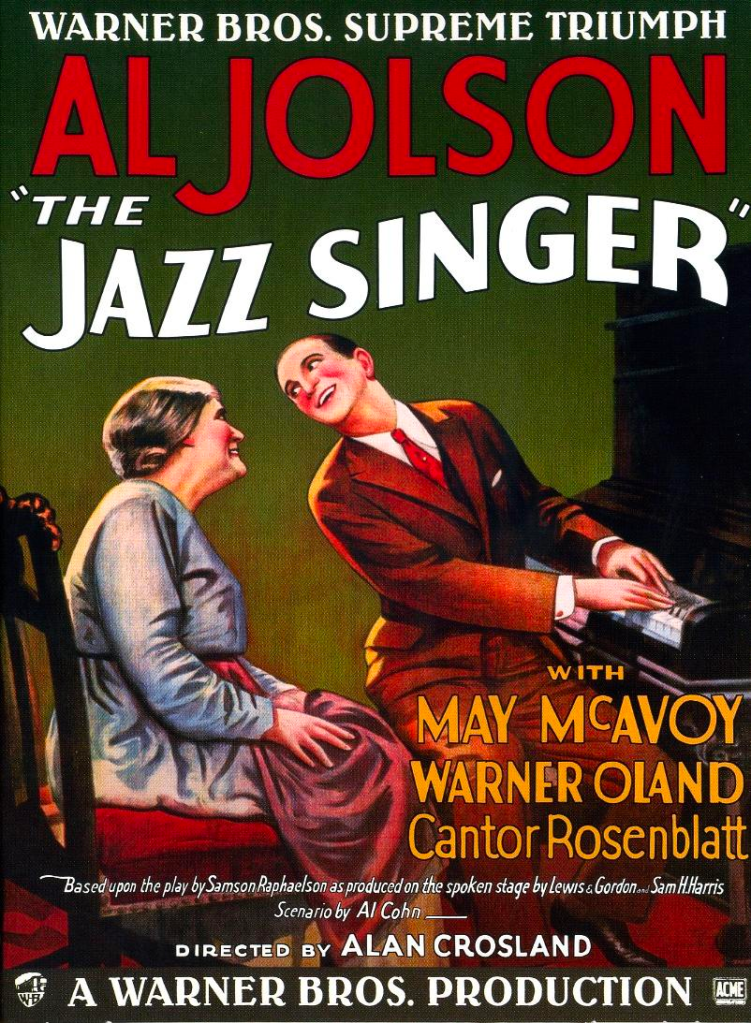
Generally accepted as the first sound film is The Jazz Singer (1927) starring Al Jolson. I was mildly charmed by it in its first hour, probably the most compelling bit in this film is when Jolson’s character utters the “first” spoken words in film history: “Wait a minute, wait a minute! You ain’t heard nothin’ yet!” Pretty neat! Would be even neater if “first” was accurate at all and if the movie didn’t devolve in the third act into a pandering happy ending featuring an emotional climax delivered by Al Jolson in blackface.
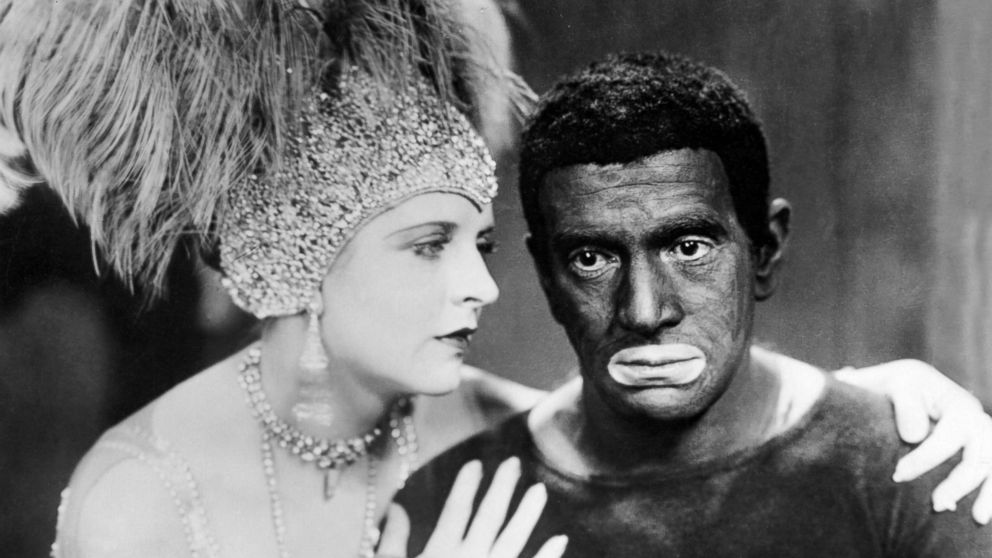
^ I can’t stress enough how bad this part of the movie is, they could have simply not done this
As for the film’s significance to film history, well it’s remembered and regarded as the first sound picture but… it isn’t. It’s also not the first film to use sound, it’s not the first film to record sound and film simultaneously, it’s not the first feature length sound film, it’s not the first anything really. It might have been the film that popularized the format in America, but that’s about all that can be said about it (at least by me).
Filmmakers had been experimenting with sound for as long as they were experimenting with film, as proven by The Dickson Experimental Sound Film (1894). The only reason it took until the late 20s for sound to be used broadly seems to have been technological and financial limitations – they could record and playback sound, but the tech was hard to use and get into theaters, it was expensive, and the audiences just weren’t ready yet, there wasn’t high demand. So silents prevailed, until they didn’t.
What I found to be a much more compelling use of sound than The Jazz Singer (in which sound is only used for small parts of the film, it is mostly silent) was Alfred Hitchcock’s Blackmail (1929).
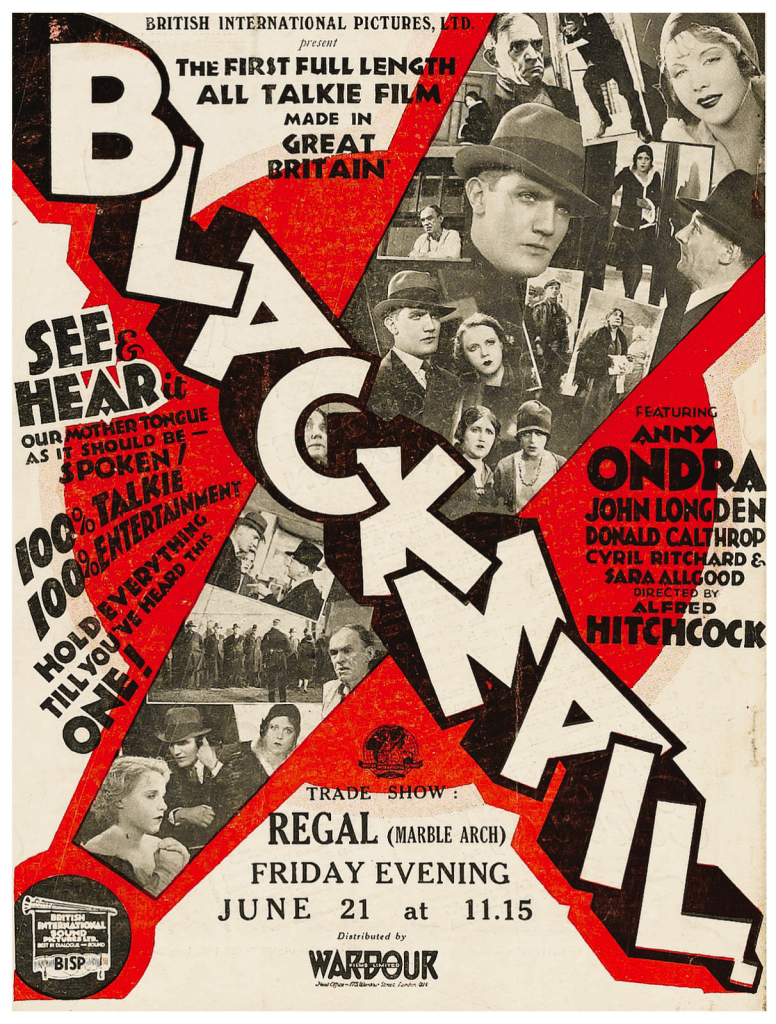
Hitchcock was a generational talent and I was really wowed by the way some sequences are able to build suspense so elegantly in this film. Further, Hitchcock uses sound not only as a story device (delivering dialogue) but as a tool of expressionism – in one scene in particular where the main character is tortured by her guilt and it is exemplified to the audience through sound, the repetition of the word “knife” over and over shows her deteriorating mental state. I loved seeing some effective experimental use of the new medium so soon after it was popularized, and this movie is worth checking out in general.
I wound up not watching any talkies from the 30s since I was covering so many topics for this unit, but by the early 1930s the silents were pretty much extinct. Talkies took over big time and the silent format was rarely used again even for the sake of budgetary concern or artistic design (unlike our next topic, which was used more sparingly for a while).
Color
As everyone knows old movies are in black and white and newer movies are in color, that’s how you can tell Clerks (1994) is older than The Wizard of Oz (1939). But the history of color being used in film was more rich than I expected. Like sound, color had been experimented with since the earliest days of filmmaking. Films discussed in the early units of this course such as The Infernal Cauldron (1903) and A Trip to the Moon (1902) were hand painted to add color to the captured film (they literally painted each individual frame one at a time). Later, creators would tint the film to add a generalized color wash over entire scenes (this was used seemingly totally at random in Birth of a Nation (1916), but to much better effect in the German Expressionist films of the 1920’s such as Nosferatu and The Cabinet of Dr. Caligari).
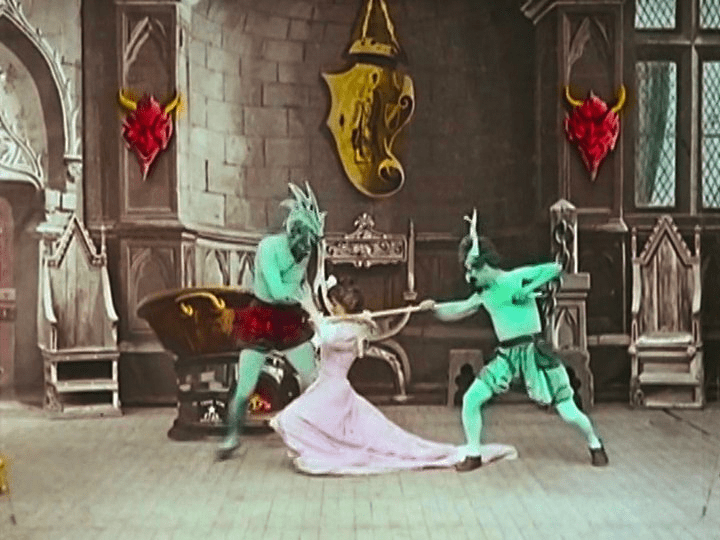
^ hand painted scene from The Infernal Cauldron
But by as early as 1917, Technicolor (which is actually a company, something I probably sort of already knew but I was never sure if it was just the name of the technology or the company that developed and sold the technology) had developed a way to shoot and project color film using their “two color process”. It was expensive and cumbersome for both filmmakers and theaters who wished to project in color, which is mostly why it didn’t really take off at first.
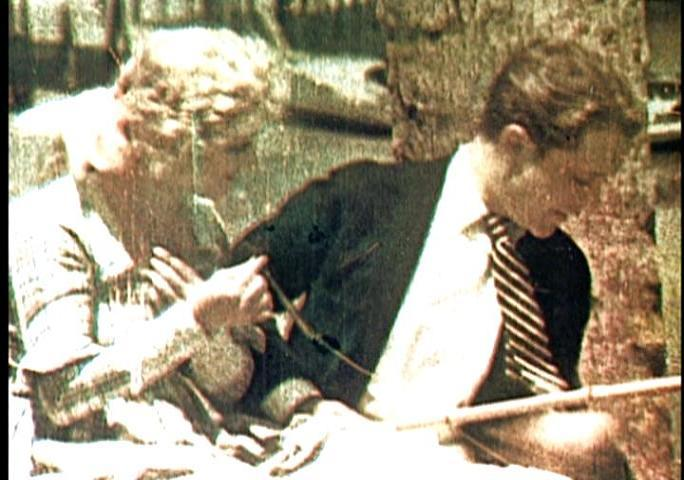
^ still from The Gulf Between (1917), the first film to use the technicolor two color process
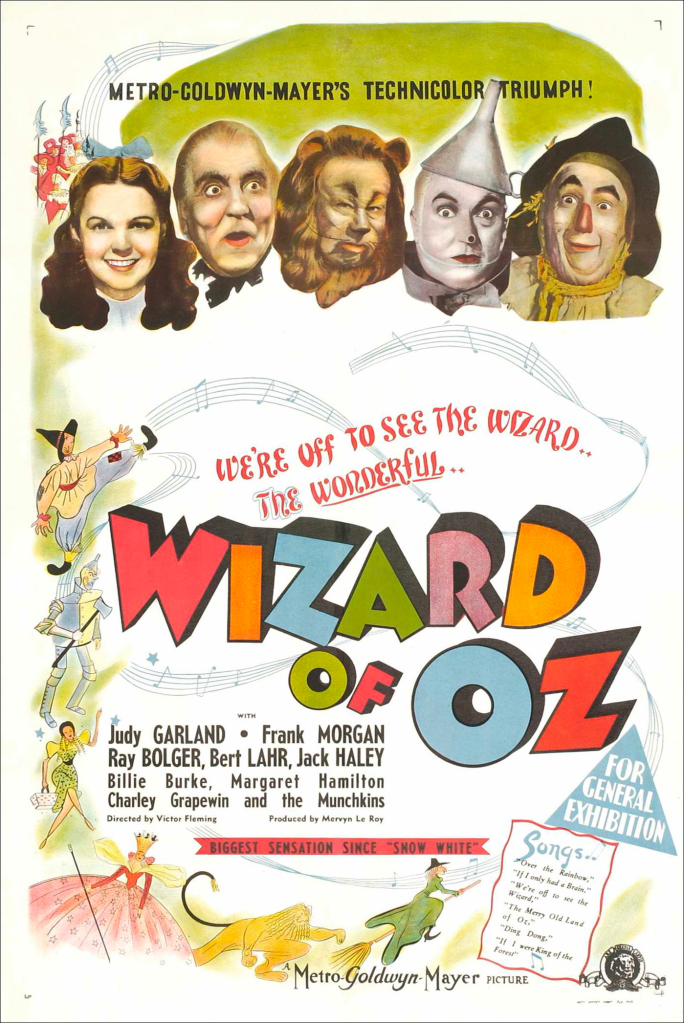
In 1932, Technicolor introduced the “three color process”, which looked better, but was still pretty cumbersome and expensive. It would be seven years before it would be used in 1939’s The Wizard of Oz, which would do a lot to popularize the color film, but it would still not become standard until the 1950s, you’ll see a mix of color and black and white films throughout the 30s and 40s. Ultimately, the turn to color came in lockstep with the transition to widescreen – both made standard in efforts to combat the growing popularity of television (presented in black and white 4:3 format).
As a brief aside, I find this phenomenon of the rise of TV driving a shift in the stylization of movies in the 50s to be really interesting as a parallel to what we see right now in the kinds of movies that are getting wide releases that people are consuming most of their media (be it film or TV) at home. It seems to be that the industry is shifting to more big spectacles, and away from small, isolated dramas that could work just as well in a living room. Not relevant here but super fun to think about!
The Hays Code
The third and final big development of the 30s that I wanted to cover before moving on to the 40s was the establishment of the Motion Picture Production Code, aka The Hays Code. The Hays Code was imposed by the Hollywood studios themselves in an effort to prevent films from being banned in parts of the US. Before the implementation of the Hays Code, each film had to adhere to the censorship regulations enforced in each municipality where it wanted to be shown. That means that if your film passed the Chicago censorship test, but failed in St Louis because of some different rules, you couldn’t show your film in St Louis. Or you might have to send a different cut of the film to be shown in St Louis, but then you might need to send a third cut to Tallahassee. It was all very hard to manage and costing the film industry a lot of money and energy.
So they opted for self-censorship under the guidance of William H. Hays (by all accounts, this guy was a real square). Hays imposed a set of rules that all major Hollywood studios would have to abide by, and for the most part all of the various censorship committees across the US would be satisfied as long as none of the Hays Code standards were being broken.
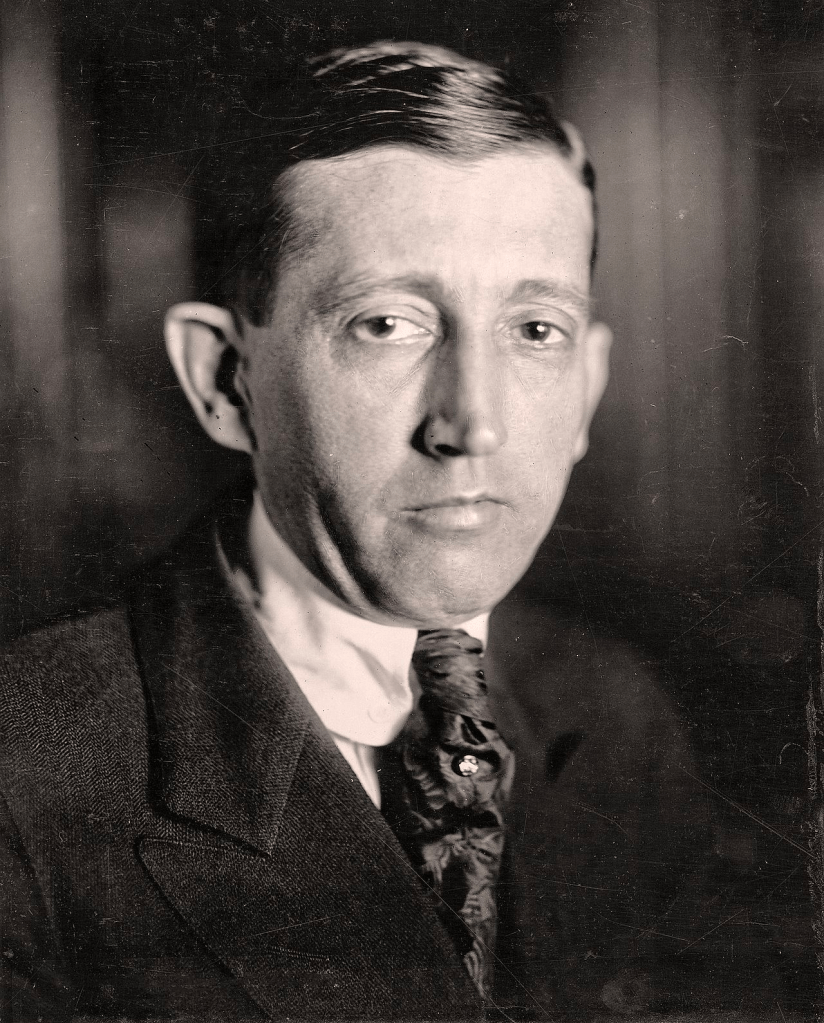
^ William H. Hays, looking awful satisfied with himself
For the most part, the strategy worked. All the studios kept to the code with their films from the 30s through much of the 1950s, and the local censorship groups basically quieted down. Hollywood was saved at the cost of creative freedom. By most accounts, the industry was in need of some kind of course correction. Censorship on this scale is never really a good thing, and the Hays code played a big role of the moral policing that dominated American culture throughout much of the 20th century and served as much to stifle social progress as it did to retain “American values”, but the Hollywood film industry could probably not have carried on the way it was going. Drugs, sexual assault, death by either negligence or bold faced murder were all rampant, not to mention the skeevy business practices discussed in some of my previous posts. Something needed to change, but the pendulum did swing pretty far in the other direction (see also William Randolph Hearst, who was stiff enough to make William H. Hays look like Steve McQueen).
So for better or for worse the so called ‘pre-code Hollywood’ was no more and films would now follow a strict set of morals for almost 30 years, until the influence of television and growing foreign film markets would force the American film industry to abandon the code and once again produce more morally ambiguous (aka interesting) content. With the abandonment of the code came the introduction of the MPAA Rating System of G, PG, PG-13, etc, that is still used today.
Well, thats all for now, sorry for the long break between posts, but life got in the way! The next unit in this course covers The Golden Age of Hollywood, so stay tuned.
 Loosely Scripted
Leave a comment