
READINGS: Film Noir: An Introduction by Mark Bould
VIEWINGS: Double Indemnity (1944), Detour (1945), Sunset Boulevard (1950), Vertigo (1958)

We’re back baby! This go-round we’re looking at Film Noir. The reading in this case actually helped me understand why the idea of Film Noir had always been somewhat elusive to me. Mark Bould proposes that, while Film Noir is often regarded as a genre, it’s actually more accurately described as a style. Its most defining characteristics are the chiaroscuro lighting (remember? from the German Expressionism post?), the presence of the femme fatale character and an unordained detective protagonist.
Here’s what I expect to see when a film is advertised as a noir: some guy (usually not a cop, but often in some investigative field) finds himself mixed up in some scheme, almost always cooked up by some external party. At the center of this scheme lies the aforementioned femme fatale, the beautiful steamy temptress who delivers our protagonist deeper and deeper into the abyss of intrigue. After a series of twists and turns and crosses and double-crosses the protagonist almost always winds up dead or otherwise defeated, and often at the hands of the femme fatale (hence the nomenclature).
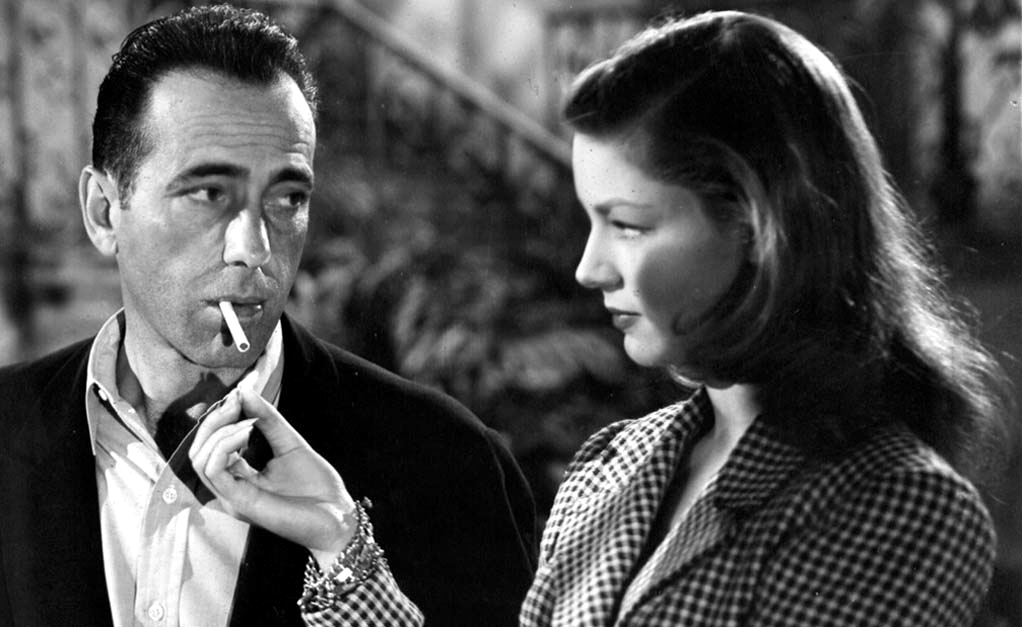
But more than these general plot points and characters, I expect some specific stylistic choices. We mentioned the chiaroscuro lighting, but we should also expect other visual cues, like urban landscapes – shady barrooms, rain-drenched city streets, dusk-lit mahogany offices. Then there are the recurring narrative devices, like flashbacks and voiceover. These cues go as far to define the “film-noir” genre as any of the character or plot similarities.
The last notable defining characteristic of film noir is theme. The movies are often exploring post-WWII anxieties like increased urbanization and the fading American dream, threatened traditional masculinity after women entered the workforce during the war, and economic uncertainty after the great depression. The biggest commonality between the noirs that I watched as part of this unit is that the outlook is the same when exploring all these themes: grim. Our main characters are basically riding a handcart to hell, driven by external factors and there is never any hope of getting out alive. The plots are deterministic and fatalistic, and there is nary a happy ending in sight.
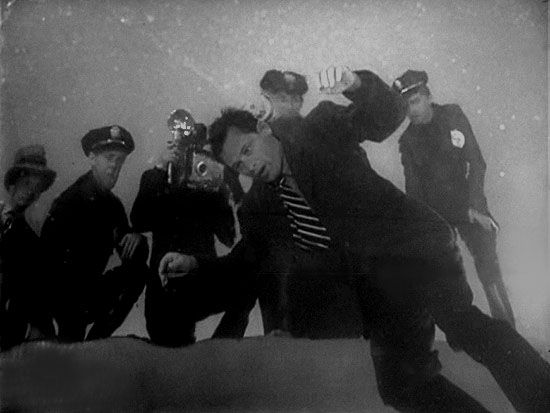
It’s interesting to see this perspective in Hollywood productions from the 40s and 50s, with the knowledge of what’s coming for America later in the 70s, 80s and 90s. The American dream shifts perhaps from the pre-war vision, but does largely rebound. This noir anxiety actually mirrors the current social anxieties explored in films (and elsewhere) today, not necessarily the same specific issues, but it’s the same disillusionment with American socioeconomic standing and geopolitical uncertainty at the root. Personally, it’s easy to overlook the dark times of the 20th century when considering American culture, and I think this study helps to highlight that things weren’t always as rosy as they sometimes feel, and prosperity always ebbs and flows.
In addition to coloring my understanding about American political outlook, studying film noir of course informs my knowledge of more modern movies as well. The noir style is borrowed constantly, frequently even used as overt parody as in Into the Spiderverse (2018). Movies like Gone Girl (2014), Zodiac (2007), and Memento (2000) use the noir flagship characteristics like the femme fatale, voiceover, or chiaroscuro, paying homage to the lineage of noir films to which they add. Some of my all time favorite movies like The Big Lebowski (1998), or Basic Instinct (1992) are basically love letters to the genre. Knowing more about the history of these movies has definitely helped me understand these contemporary pieces better and allows me to see these aspects of my favorites in a new light.

^ John Wick (2014), Oldboy (2003), and Drive (2011) also derive much of their styles and plots from noir. See also: Heat (1995), The Dark Knight (2008), The Batman (2022), Jackie Brown (1997), Blade Runner 2049 (2017), and Se7en (1995), just to name some of the more recent examples.
Okay, that’s all for now, sorry for the break (I had to focus on my real, actual job for a while), but I hope to get back to this with some more regularity. Next time we’re studying Italian Neorealism, but for now “River dirt chi”, or whatever.
 Loosely Scripted
Leave a comment